By Steve Toloken
STAFF REPORTER / ASIA BUREAU CHIEF
Published: October 14, 2014 6:00 am ET
Updated: October 14, 2014 11:36 am ET
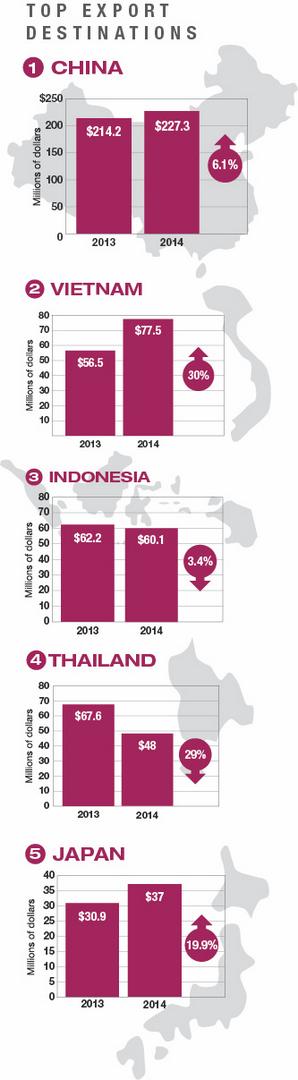
Image By: Graphic by Jessica Jordan
TAIPEI, TAIWAN — Taiwan’s plastics and rubber machinery industry, one of the world’s largest exporters of plastics equipment, is projecting a modest recovery in the second half of the year, led by sales of the iPhone 6 and other smartphones.
Judging by interviews at the Taipei Plas show in late September, the industry is looking to ride the coattails of Taiwan-based manufacturing giants like Foxconn and Pegatron.
But it’s not exactly a fast ride.
The local plastics and rubber machinery industry saw exports increase a modest 2.3 percent, to $831.3 million, from January to August, and they expect final 2014 figures to show a roughly 5 percent increase in sales, said David Wu, head of the plastics and rubber machinery committee of the Taiwan Association of Machinery Industry.
While that’s not huge growth, Wu said it would be a turnaround from the first half of the year, when plastic and rubber equipment exports dropped about 2 percent, to $599.6 million, compared to the same period in 2013. That came on top of a 6 percent drop in exports last year.
“It is not very impressive growth but looking at other economies it’s acceptable,” said Wu, who is also the general manager of vertical injection press maker Multiplas Enginery Co. Ltd. in Taoyuan. “I believe we can expect even better numbers in the coming months because of the iPhone 6. We also have many orders from Samsung.”
Taiwan’s machinery industry exports more than 80 percent of its equipment, with mainland China the largest market, accounting for between 25 and 30 percent of exports.
TAMI said Taiwan is the world’s fifth largest producer of plastics and rubber machinery, with production value of $1.51 billion last year.
The island, with only 23 million people, has a high concentration of plastics for its size, and is the world’s fourth-largest exporter of plastics machinery, behind the much larger economies of Germany, Italy and Japan, TAMI said.
Taiwanese manufacturers like Foxconn hold key places in the global supply chain for electronics. Wu also pointed to some growth in automotive manufacturing helping local machinery makers.
The Taiwanese industry’s modest rebound in the second half of the year comes after a tough 2013, when exports declined 6.2 percent to $1.26 billion, which TAMI blamed on slower growth in China and weakness in the euro zone economies.
In the first eight months of this year, however, Taiwan has seen machinery exports to China rebound. They grew 6 percent, to $227.3 million.
Exports to the No. 2 market, Vietnam, soared 30 percent, to $73.5 million, lifting Vietnam past Thailand and Indonesia as an export destination.
Elsewhere, it was mixed. Taiwanese companies traditionally focus on emerging markets in Asia, but they have also scored gains this year in the more developed economies of Japan and United States.
Exports to Japan, its fifth-largest market, rose 20 percent to $37.5 million, while exports to the United States, ranked No. 6, rose 26 percent to $32.6 million.
But sales to some key emerging markets were down: exports to Indonesia and Thailand, ranked third and fourth, fell 3 percent and 29 percent, respectively. And sales to India, ranked No. 7 on the export list, dropped 39 percent.
Taiwanese companies said they were trying to expand exports to Africa, the Middle East, South America and Eastern Europe, and they scored some sizable gains, although from relatively small bases.
“The biggest issue that the Taiwan plastics and rubber machinery industry faces is being over concentrated on the China and Southeast Asian markets,” according to an analysis from TAMI prepared for the show.
John Hsu, chairman of TAMI, said Taiwan’s been hurt by less investment and currency depreciation in emerging markets like Turkey, India and Southeast Asia.
China and Southeast Asia occupy 56 percent of Taiwan’s machinery exports, while the Middle East, Africa and South and Central America each account for only seven percent. But the recent growth has been in those smaller markets, industry figures show.
Exports to Russia, for example, rose 49 percent to $24 million last year, while sales to companies in Mexico jumped 67 percent to $23 million.
Exports to Nigeria, South Africa and Algeria rose 61 percent, 21 percent and 26 percent last year, to $15.5 million, $13.1 million and $10.9 million, respectively.
Industry officials said they were hopeful for a turnaround in the rest of 2014.
“I’m very optimistic for our development for the second half of the year, judging by our ability to meet customer specifications,” said Michael Wang, one of the vice chairman of TAMI’s plastic and rubber machinery committee and an executive at Hong Kong-based Chen Hsong Group, which has a machinery factory in Taiwan.
Organizers of the Taipei show also pointed to increased attendance and participation at the show as evidence of market promise.
The five-day show had 18,600 attendees, a 17 percent increase from 2012, and 2,700 international visitors, an 8 percent increase. The show attracted 530 exhibiting companies, an increase of 12 percent from the last edition in 2012. |